When I was growing up, the parochial school near my home bore those yellow-and-and black fallout shelter signs. Looking back, I can’t really recall when they disappeared – the early 70s maybe? Later, perhaps? An article in today’s New York Times left me wondering whether my kids will see those signs in the future.
That piece explains that the Obama administration is facing a dilemma. Research has concluded that in case of a nuclear attack, you should not flee but instead get inside and stay inside until it is declared safe. The Times’ article further states that scientific studies indicate that shielding yourself from the lethal radiation that follows a nuclear strike could potentially save hundreds of thousands of lives. Thus the administration’s is facing a catch 22; should they publicize the data on how to best survive a nuclear attack and appear alarmist? Or, should they steer clear of any sort of public-education campaign and deprive the public of important public safety information?
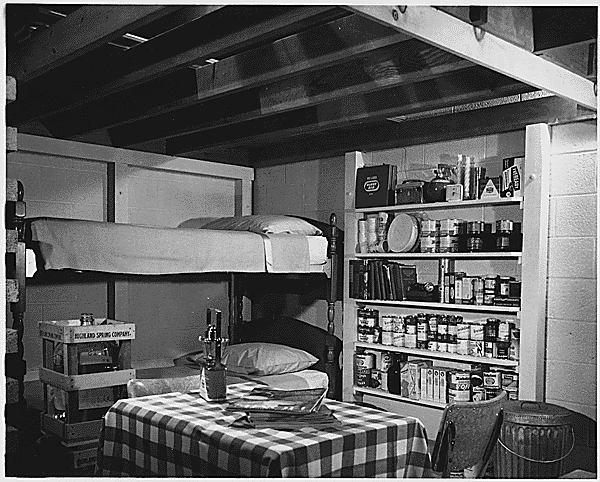
Back in the 1950s and 1960s, there didn't appear to be any such hand-wringing going on. The government excelled at distributing alarmist material - pamphlets provided instructions for developing a family fallout shelter, pictures captured families posing in their underground bunkers, cartoons of the effects of the lethal fallout were printed and lists of items individuals should have on hand were distributed to those fearful of what would happen if the bomb dropped.
Some of those materials can be found at the National Archives. Teacher’s resources provided by that federal agency give access to a digitized copy of pamphlets distributed by the Federal Civil Defense Administration, photographs of a family fallout shelter as well as other material. The U.S. Department of Energy’s Department of History & Heritage Resources features additional print and visual fallout materials.

The photo above left comes from the National Archives. It’s depicts a fallout shelter constructed by a Michigan man to protect his family of four. The shelter, which had an ample stock of food supplies, also featured special ventilation and an escape hatch. The photo at right of the fallout shelter sign, that symbol I remember from my youth, comes from the Federal Environmental Protection Agency.


 Posts